Powderpost beetles and anobiid wood borers cause measurable structural damage across older crawlspaces and historic foundations in St. Elmo, Highland Park, and North Shore. Female beetles deposit eggs within…
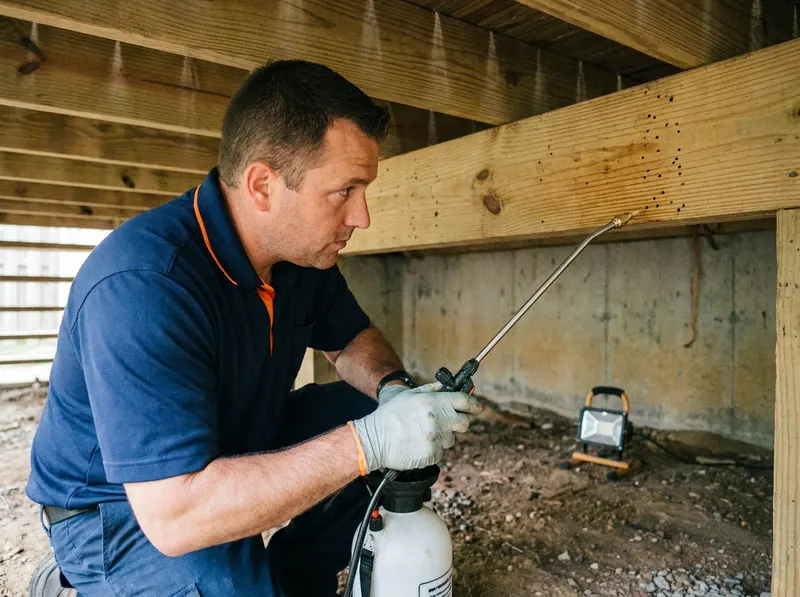
Powderpost beetles and anobiid wood borers cause measurable structural damage across older crawlspaces and historic foundations in St. Elmo, Highland Park, and North Shore. Female beetles deposit eggs within microscopic pores of exposed hardwood and softwood framing. Once hatched, larvae feed internally on starch for 1 to 5 years, reducing structural load-bearing timber to fine, talc-like frass before emerging as adults through 1/16-inch to 1/8-inch exit holes. Topical retail sprays fail to address these infestations because oil- or pyrethroid-based surface treatments do not penetrate past the outer 1/32 inch of the timber. Effective intervention requires pressurized liquid borate salts that absorb deep into the wood cellular structure, poisoning active larvae as they ingest fibers and crystallizing inside the pores to prevent re-infestation.
Structural remediation decisions depend on wood moisture levels and ambient relative humidity. In the Tennessee River Valley basin, especially low-elevation properties near Lookout Valley, Riverview, and the Tennessee Riverpark, subfloor timber frequently absorbs atmospheric moisture above 18%, creating ideal conditions for anobiid beetle colonization. If subfloor moisture registers above 20%, borate application must pair with vapor barrier installation or crawlspace dehumidification; borate salts cannot bond permanently within saturated lumber that experiences standing ground water. Conversely, timber with moisture below 12% rarely supports new larval development, meaning visible exit holes in dry wood often indicate inactive, historical damage that requires physical probing and frass testing rather than immediate chemical saturations.
Treatment operations avoid corporate quarterly spray subscriptions. Structural applications utilize specialized low-pressure sprayers calibrated to flood bare timber at a rate of 1 gallon of finished solution per 100 square feet of wood surface area. Once applied, disodium octaborate tetrahydrate penetrates unsealed wood, while bonded interior finishes like paint or polyurethane require mechanical stripping or specialized structural micro-injection to achieve chemical contact. Pets and residents must vacate the immediate crawlspace perimeter during liquid application until surfaces dry fully, which typically takes 2 to 4 hours under proper mechanical ventilation.
Every job gets a firm, written price after a free on-site visit.
Tell us about your wood-destroying beetle remediation job in Chattanooga and we'll send a clear, written quote, usually the same day.
 Halvex Pest InterventionC